Function and Superpower are the two biggest players in the blood work space: annual membership panels that test 100+ biomarkers, run your results through their own software, and hand you back an interpretation and a plan.
I personally paid for both, went through both platforms, and reviewed both sets of my results. Here's what we're going to cover: what each one costs and what you get, my experience of the process and the UX and UI of each platform, the key differentiators, who I think each platform is actually right for, and my honest score for each one.
I've personally spent over $300,000 on my own health, and I really wish I had just started doing my blood work sooner. It would have saved me a lot of time, a lot of money and a lot of energy, because if you don't test, you're basically guessing. Don't make the same mistake I did.
Let's dive in.
What you get
Function gives you 100 biomarkers on your first blood draw and another 60 at six months. A clinician reviews your results and sends notes on anything out of range and why that might be happening. The AI has your health history from the intake plus all your lab results, and connects to your wearables so it can fold that data into the feedback. You get discounts on MRIs and full body scans through their Ezra partnership, deeper add-on testing if something comes back out of range, and a tab where they build out specific plans for you off the AI and your data.
Superpower gives you 100 biomarkers with their annual blood draw, plus 24/7 concierge support with MDs, naturopaths and functional diagnostic nutritionists who answer via text within a 24-hour response time. Their AI has your full family and health history, anything you upload, and everything coming in through your labs. There's a marketplace with discounts on supplements, prescriptions and peptides plus additional testing, the ability to upload old or new data from anywhere and integrate it into your trends, a customized action plan, and wearable syncing.
The process and the platforms
Both work pretty similarly. You sign up, fill out a big health questionnaire, and schedule a time to get your blood drawn.
Function
They partner with Quest, so you find one near you, go fasted, and get drawn. Within a few days results start populating in your dashboard, and once everything is in, a clinician reviews your case and writes up what you should be looking at and what they think you should do.
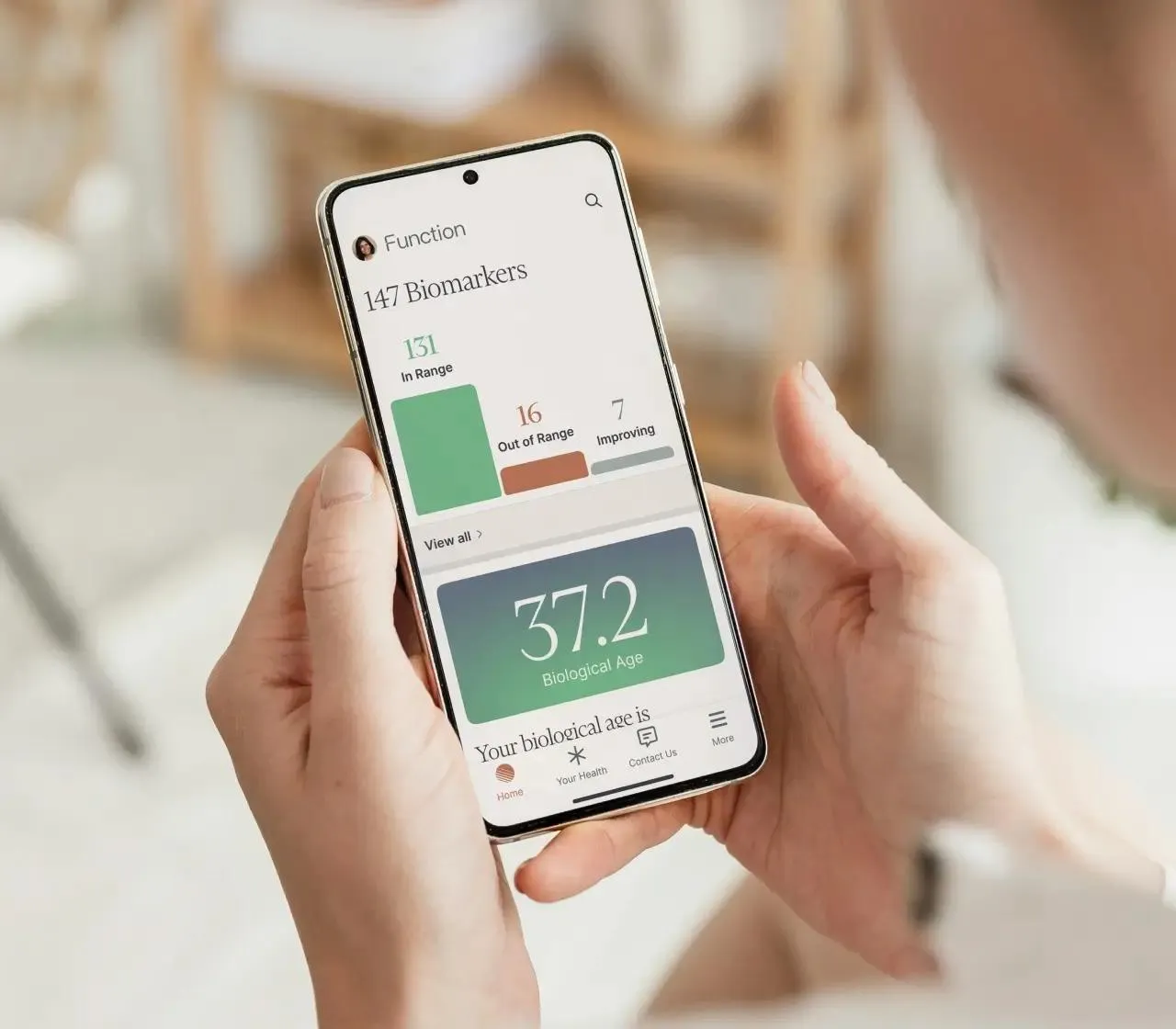
Jumping in, it's very clear what's in range and what's out of range, with your biological age at the top. Mine came back 13.3 years younger than my calendar age. I'm 32, and it's saying 19.2. It's a nice little gold star. Below that are the aspects of your health that are in or out of range, and you can jump into any category from the side, order more labs, schedule your follow-up, or open the AI chat, which gives you automatic prompts like "help me address my brain fog" as well as your own conversation. The clinician notes go through each blood marker in good detail, so you're going to learn a lot reading through them.
Superpower
Same process, except you can go to Labcorp or Quest, so there are more options. The cool part is they can send someone to your home. If you'd rather have a phlebotomist come to your house, you pay an extra $119. Throughout the process they text you: your draw is coming up, fast the night before, appointment reminders, and a notification the moment results start coming in. Results land somewhere between 2 and 5 days after your draw.
The home tab is your Superpower score and your biological age. Mine was 86 out of 100, and my biological age wasn't as low as Function's but still quite a bit younger. Both platforms give you this little report card thing when you log in. The data page lets you see results within the context of each organ system and click into any one. When I clicked into creatine, the AI gave me prompts explaining why my level was optimal and what that means. The action plan section lays out next steps as step one, step two, step three, plus recommended testing or supplements off your data, each one explaining why it matters and giving you the citation.
What I like about Function
They did an incredible job on the intake. More questions, a deeper dive on family history, and they really armed the AI with as much data as possible on the front end. Everything from signing up to seeing results was streamlined, and I loved how quickly results came in.
It's a simple, clear visual. Looking at it by system, it seems like my heart is maybe a really big opportunity when I'm thinking about improving my health, and I love that view of it. When you double click a biomarker that's out of range, they give you a bunch of detail on why it matters, what might be causing it and what to do about it, plus targeted recommendations on foods to eat, lifestyle changes, or supplements to consider.
I personally love that they include thyroid antibodies, as well as heavy metals, lead and mercury. Hashimoto's is one of the most prevalent conditions in the Western world, and environmental toxins affect a lot of people. The fact that both are on the first panel is awesome.
I also love how many options they give for additional testing, specifically the CIRS panel, chronic inflammatory response, which a lot of companies don't even know about and which I feel should be included in most tests. I will say it's massively overpriced. I'm happy they have it, but there's no reason it should be $700.
And I'm a big fan of Mark Hyman. He puts out really good content and he's helping a lot of people learn about the more integrative, holistic approach to medicine and healing.
What I like about Superpower
One thing that really blew me away was the ability to pull my previous bloods and integrate them immediately into my dashboard. I haven't seen any other company do anything like this. Seeing your trends over time can't be understated, because that's what guides you toward the best decision about what to do with your health right now.
The other thing I absolutely love is the concierge support from the care team. Getting access to doctors and nutritionists at this price point is kind of insane. And I loved all the little touch points along the process. It made me feel like I was being taken care of.
The action plan page also can't be understated. This is one of the biggest pieces of feedback I gave them in my previous review, and what I've said about all blood work companies: they need to condense the information into very tangible action steps. Step one, step two, step three, on an 8 to 12-week plan, means you can just do these things, report back, and keep updating with the AI to see how things are progressing.
Their AI is extremely sophisticated and it really blew me away. I've had incredible back and forth with it on very complex health questions, and the nuance and specificity were impressive. You can also connect a conversation you've been having on another AI platform like ChatGPT or Claude. I haven't played with that feature, but I love how quickly this platform is getting better.
The dashboard is intuitive and simple, and it feels like anyone can use it. I love the marketplace, because as someone who spends a lot of money on supplements it's nice to get a discount, up to 20% on most of them, and get prescriptions in the same place. They've also just added the VIP nasal spray, which is really important for people working through a chronic inflammatory condition, which is what I've been dealing with.
My critiques of Function
The thing that's really missing is the follow-through on support and next steps. People are already overwhelmed with their health, and then you give them a lot of data. That's a great step in the right direction, but normal everyday people, whose job isn't to test themselves and understand all this, get very overwhelmed by the amount of information inside Function.
I know this firsthand. I encouraged a family member to get tested through Function and we found out he had Hashimoto's. He didn't know what to do, so he took it to his GP, who referred him on, and it took weeks to get that appointment. Then that doctor said he needed scans. It's been months since his blood work came back and nothing has really been done. The information is in there, which foods to eat, which to avoid, which supplements to consider, but it's so much information that he got analysis paralysis and did nothing.
People need hand-holding through this, especially with a significant condition. I'll be the first to say people should take full agency over their health and become their own doctor, but that's the problem that actually needs solving. Not just "here's what's going on", but "we're going to help you sort this out".
My other critiques:
- The interface isn't very intuitive. My family member got overwhelmed and found adding more tests confusing. I can navigate it okay, but it feels clinical and it's easy to get lost in the sauce.
- No marketplace or clear next step. People left to their own devices without a clear next step are just not going to take action.
- Uploads don't integrate. You can upload tests from elsewhere, but they don't fold into your existing data. Labs from another company or from previous years should build into the ecosystem and be usable in real time.
- No at-home draw. You have to go to Quest. Adding at-home testing feels like an easy no-brainer.
- The clinician notes were a little surface level. There's good information in there, but there was a miss on my heart health. Some numbers are elevated because of the chronic inflammatory condition and autoimmune stuff I'm working through, and I'm watching them trend down as I get healthier. The notes didn't fully get that even though I'd already given them all that information. If I hadn't known this beforehand, it could easily have led me down the wrong road. These notes are not gospel. Use them as one data point in a bigger data set.
- The AI is still in beta. It missed some of the same things, and when I asked why, it didn't come up with a great answer. I'll give them grace, it's still building out its learning model.
- No step one, step two, step three, and no timeline to map people onto where to go next.
My critiques of Superpower
The thing that really bugs me: when you go to prescriptions, the first thing you see is semaglutide. I hate this. Everything is customized, so there's no reason I should be seeing it, and considering the ethos of the platform and what the company is about, it feels very off-brand. This needs to go. I get that if you're really overweight you might need it, and people talk about microdosing, but as a consumer it doesn't feel good when it's not what I need. Based on everything I gave the AI in the intake, the VIP nasal spray should be in that first slot.
My other critiques:
- Concierge lives on your phone. You should have the option to text the care team on your phone or inside the platform. Both companies have a great app, and you should be able to keep people there and text the team the same way you text the AI.
- A few minor bugs. On my data tab, DNA health is grayed out even though I have markers filled in. Toxic exposure being grayed out makes sense, I haven't tested anything there. But my immune system has a bunch of markers tested, so there should be a grade showing.
- No thyroid antibodies on the base panel. It's common enough that it should be standard everywhere, and right now it isn't on their 100 biomarker panel.
- Less testing depth. You can do a gut test, heavy metals, environmental toxins, mycotoxins, a deeper cardiovascular panel, an autoimmune panel and a cancer test, which is a lot. But it isn't close to the number of options Function gives you.
- No imaging. If you want MRIs, CT scans or whole body scans, you'd have to do it outside Superpower and import the data in.
Pricing and the head-to-head
Function is $365 per year, which gets you the 100 biomarkers plus the 60 biomarker retest. A full retest of all 160 is $309. Superpower is $199 per year, and a full retest is the same price, $199. With my codes, Function comes down to $340 and Superpower comes down to $169.
Here's how the two map against each other:
- Annual price: Function $365, $340 with my code / Superpower $199, $169 with my code
- Biomarkers: Function 160 / Superpower 100
- Full retest: Function $309 / Superpower $199
- Concierge support: Function none / Superpower included
- AI chat: both
- At-home blood draw: Function no, you go to Quest / Superpower $119 add-on
- Auto-pull of previous blood work: Function no / Superpower yes
- Supplement and prescription marketplace: Superpower only, with 20% off supplements
- MRI and CT scan add-ons: Function only
- Thyroid antibodies: included on Function / upgraded panel on Superpower
- Heavy metals: included on Function / upgraded panel on Superpower
- CIRS test: Function only
The differences that actually decide it
The concierge gap. With Superpower you get ongoing support. With Function you just get the clinician notes. This is a big deal. If you feel like you need ongoing support and want to talk to real people, Superpower stands out.
Winner: Superpower
Biomarker coverage. Function beats out Superpower by a little here, because the initial panel includes thyroid antibodies and heavy metals, and I think those things are important. On top of that you can do way more extensive testing through the add-ons.
Winner: Function
Add-ons and extras. Function can do the MRIs and CTs and Superpower can't. But Superpower can send someone to your home and Function can't, Superpower grabs all your previous data and adds it into your timeline right away, and Superpower has the marketplace.
AI support. Superpower's AI kind of blows away Function's. I'm super impressed with how sophisticated it is and how much it can really do. Function's has a long way to go and needs work.
Winner: Superpower
User interface. Superpower is a clear winner here for me too. The way Function set up their dashboard just isn't as intuitive. It feels like a Microsoft vs Apple kind of situation.
Winner: Superpower
Who each platform is for
Function
- You want maximum biomarker coverage and as much testing done as possible
- You're always skipping your annual physical, you feel a little off, and you don't know why
- You want the discounts on CT scans, MRIs and whole body scans
- You're already comfortable navigating and interpreting your own health data, so all the information won't feel like drinking out of a firehose
- You want a broader baseline that covers a lot of bases
Superpower
- You want to talk to a real person after your results come back instead of just reading a report
- You want more guidance and hands-on support because this is new territory and going through it alone could feel overwhelming
- You want to keep costs low, especially if you're going to retest a lot over time
- You're short on time, or you hate going to the lab and want someone to come to your house
- You want to interact with a really powerful AI to build custom plans and interpret data, and you're comfortable asking questions and working out the best plan for yourself with the technology supporting you
- You want to integrate data from all your different labs and see it on one timeline
- You spend a lot of money on supplements like I do and want the discount
Something else that stands out about Superpower: it's a more modular approach. Function gives you a broader baseline. Superpower is lower cost, but once you add on other tests it'll probably come out about the same, so you can dive more specifically into what you want rather than casting a wider net.
My scores
Five categories, out of 10 each.
Function
- Effectiveness: 8/10. Great biomarker coverage, but the AI needs work and the clinician notes were a little sus for my particular situation.
- Service: 9/10. Really great from start to finish. When there was a glitch, I emailed them, they said they'd streamline my results within 72 hours, and they did.
- Price: 9/10. $365 for 160 biomarkers is an amazing deal, and $340 with the code. A few years ago this would have cost potentially thousands.
- Experience: 8/10. Really great, but the interface needs simplifying and so does the action plan.
- Daddy factor: 8/10. This product absolutely revolutionized healthcare, and it's about to get really crazy as more companies enter the space.
Total: 42/50
Superpower
- Effectiveness: 9/10. The auto data pull, the concierge and the marketplace are epic.
- Service: 10/10. The touch points are amazing, every problem gets fixed quickly, and the concierge is above and beyond for the price point.
- Price: 10/10. $169 with the code is kind of insane for all of this, and the retest is only $199.
- Experience: 8/10. They've already made changes off the feedback I gave them last time. Lose the semaglutide, fix the last few bugs, and it's a 10.
- Daddy factor: 9/10. For me this is top of the top, and I'm excited about how quickly the changes are happening.
Total: 46/50
Final verdict
I love both of these companies. I love what they're doing, and I love that more people are going to get their blood work done. I'd feel really good recommending both of them to my mom.
If I had to pick one, Superpower wins out by just a hair for most people. The concierge access, the automatic data pull, the at-home blood draw and the price all make it a little bit better of a deal, and the user interface and the AI push it over the edge for me. But if you want maximum biomarker coverage and all those different testing options, Function still wins in terms of raw depth.
Here's the bottom line. Stop following random trends off Instagram or from your favorite influencer. Go get your blood work done, whether it's through Function or Superpower, so you can figure out what's actually going on with your health specifically. Then you can build a custom-tailored plan designed to move those markers in the right direction, based on your family history, your own personal health history, and most importantly your data.